We are already the majority
89% want climate action. This is where the majority made itself visible.
10,000+ happened Coming up
The record, 2026
10 verified marches of 10,000+ people
Coming next. Be one of them.
These dates are already set. Every one of them needs more organisations behind it, and the map still has room for your city.
Figures are as reported by organisers. Police estimates were lower in Berlin and Munich. Santiago has no official count, so we show the reported range. Upcoming marches are listed with the size of their last edition, not a prediction.
Share the film
Some networks only accept the link. The text with #theloudmajority and #wedonthavetime is copied for you.
Are climate demonstrations disappearing?
In , this map was covered in dots. Millions marched in cities around the world. Today, the streets are quieter.
But the climate majority is still here. Let’s make it visible again.
Two minutes: pick a country, pick an organisation that already has members and trust, and send them the idea.
- 10
- Verified 10,000+ marches in 2026
- 241,000+
- People in the streets in 2026
- 50,000+
- Largest single march in 2026
- 89%
- Want stronger climate action
A majority that thinks it is a minority behaves like one
89% of people want governments to do more on climate. 69% say they would give 1% of their income to climate action. Yet almost everyone underestimates how many others feel the same.
So the majority stays quiet at work, quiet around the dinner table, and watches from the pavement.
The first job is to introduce the majority to itself.
Then Stockholm happened. Organisers expected 10,000. More than 50,000 came, and a handful of organisations grew into a coalition of over 280.
Scouts came as scouts. Union members as union members. Parents as parents. Nobody had to become somebody else before they were allowed to care.
Stockholm was not an exception. It was a recipe.
50,000 is not the goal.
100,000? 250,000? 500,000?
What happens when half a million ordinary people walk through one city for a safe climate, in many cities, in the same year? Let's find out.
The trend
Are climate demonstrations going extinct?
Reported participation in large climate demonstrations, year by year. The peak was loud enough to move governments. Then the streets grew quieter, and the crisis did not.
- 241K+
- 240K+
- 116K+
- 558K+
- 320.5K+
- 780K+
- 161K+
- 11.25M+
- 360.5K+
- 2026
- 2025
- 2024
- 2023
- 2022
- 2021
- 2020
- 2019
- 2018
Click a year to see that year on the map.
About the numbers: each bar is the highest figure we have a source for that year. Where a credible global count exists for the year's strike days, we use it. Where none exists, the bar is the sum of single-city demonstrations of 10,000 or more that we could verify. The notes under the chart give both figures for every year, so you can see which is which. A plus sign means the real figure was higher. Figures count attendances, not unique people, and 2026 runs through 1 September.
- 2026
- 241,000+ documented across 10 large marches, year to date. Not counted in the total: 19,000+ nationwide in the "Es brennt!" human chains across 100+ German cities on 3 October (organisers' estimate; no single city reached 10,000); and 130,000+ across 260 French cities on 26 September (Mouvement du 26 septembre, organisers’ tally, revised up from 120,000).
- 2025
- 240,000+ documented across 9 large marches, including COP30 in Belém.
- 2024
- 116,000+ documented across 4 large marches. No global count published.
- 2023
- 558,000+ documented across 16 large marches, led by the September Global Climate Strike. Organisers reported hundreds of thousands more without a defensible total.
- 2022
- 320,510+ across the two global strike days: 250,510+ in March and around 70,000 in September. City by city we document 223,000 across 11 large marches.
- 2021
- 780,000+ documented across 18 large marches, including the September strike and COP26.
- 2020
- 161,000+ documented across 6 large marches. Pandemic year, mostly digital actions. No global count published.
- 2019
- 11.25 million+ across the year's global strike days: 1.4 million in March, 1 million in May, 7.22 million during the September Global Week for Future (Guinness World Records, 7,935 events in 160+ countries), 630,000 in Germany in November and 1 million+ in December. City by city we document 5,479,250 across 107 large marches.
- 2018
- 360,500+ documented across 12 single-city marches of 10,000 or more. No global count published.
Not disappearing. Rebuilding. The peak was 2019, with 11,250,000+ people in the streets. Stockholm showed the coalition model that can bring those numbers back.
23 August 1989 · The Baltic Way
It has worked before. Two million people stood still for fifteen minutes and the empire was forced to admit the lie.
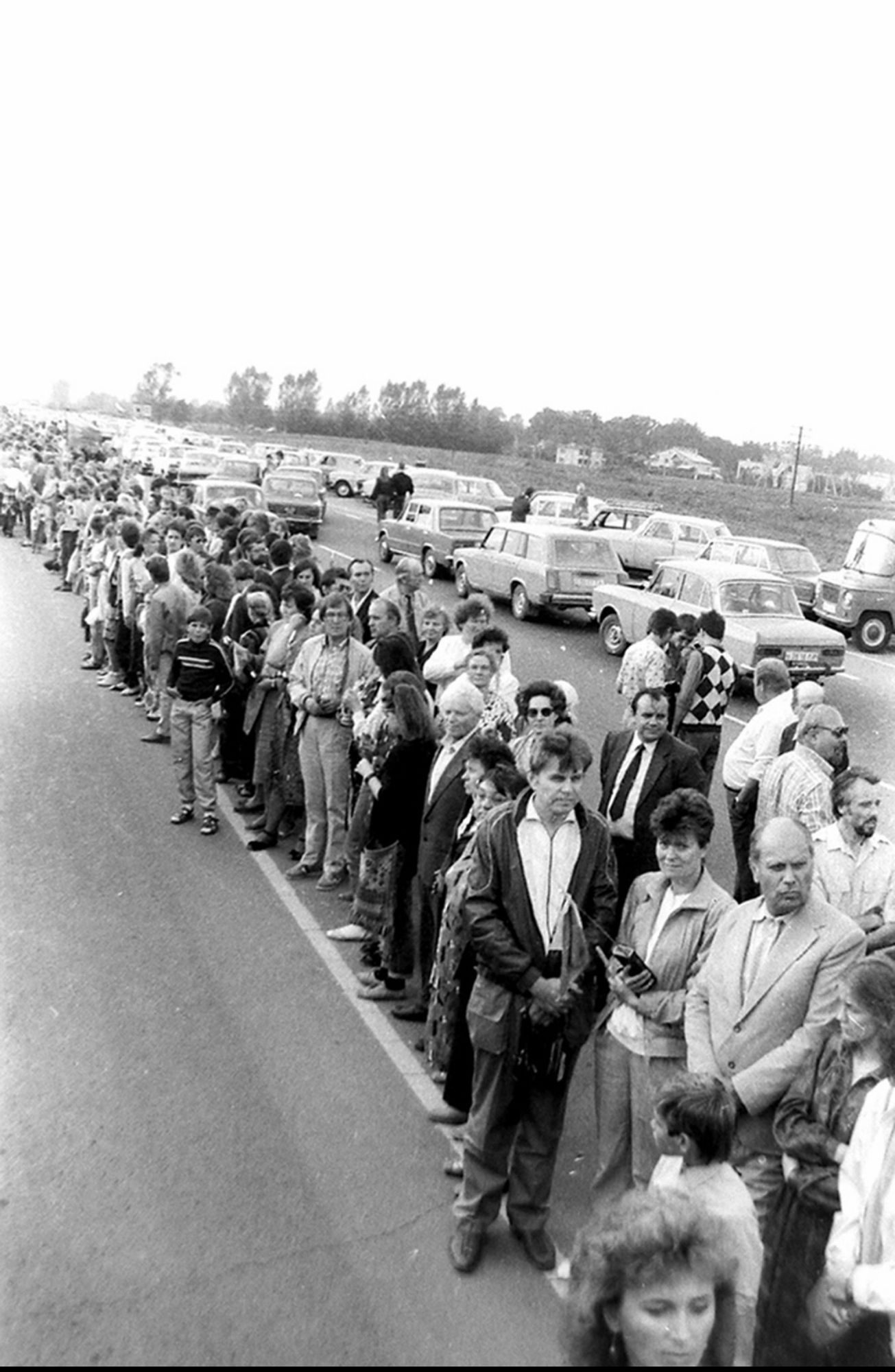
- 2,000,000
- People in one unbroken line
- 675 km
- From Tallinn to Vilnius
- 1 in 4
- Inhabitants of three countries
Estonians, Latvians and Lithuanians took each other by the hand across three occupied countries. No creative placards. No costumes. Nothing disruptive. They stood still for fifteen minutes.
Their only message was the scale. The occupation rested on a lie, the secret protocol of the Molotov–Ribbentrop pact, and the chain made that lie impossible to keep telling: this many of us see through you. Four months later the Soviet Union admitted the protocol. Two years later all three countries were free.
The chain was not built person by person. It was built by movements bringing their own: villages, workplaces, choirs, families. Grandparents who remembered independence stood next to their grandchildren. Nobody had to become an activist to stand in it.
Exactly 37 years later, to the day, 50,000 people walked through Stockholm on the same recipe. The only question left is the number.
Want to make 50,000 look small?
Here is the Stockholm recipe, plus what the We Don't Have Time team learned on the ground about scaling it.
Steal it. Improve it. Scale it.
It is the Baltic Way method: coalition first, come as you are, and let the scale be the message.
This is not a rigid formula. Different countries and cities need different approaches. These are ideas for making a climate march feel hopeful, broad and genuinely owned by the people taking part.
- 01
Start with organisations, not followers.
Do not begin by trying to persuade 50,000 individuals one by one. Start with a handful of organisations that people already trust.
In Stockholm, a small core eventually became more than 280 participating organisations.
- members
- mailing lists
- local chapters
- networks
- infrastructure
- meeting places
- credibility
- relationships
Don't build one audience.
Connect many communities.
- 02
Make it look like society.
The more different faces people see, the harder it becomes to believe climate concern belongs to someone else.
- environmental organisations
- unions
- companies
- employer organisations
- universities
- students
- schools
- churches and faith organisations
- scientists
- doctors and nurses
- teachers
- sports clubs and supporter groups
- pensioners
- scouts
- artists and musicians
- parents
- community and neighbourhood groups
- professional associations
Diversity is the message.
- 03
Timing matters.
Organise close to a moment when people, and leaders, are already paying attention.
A huge demonstration is powerful. A huge demonstration at exactly the moment leaders are deciding something is even harder to ignore.
- an election
- a parliamentary vote
- climate legislation
- a budget decision
- a local political decision
- a climate summit
- an important court decision
- a major political speech
Be loud when it matters.
- 04
One march. One core message.
Do not try to communicate every climate policy at once. Choose one short, human idea that works on television, in headlines, on social media, in conversation, and when explaining the march to a child.
One central message. Tens of thousands of personal reasons for showing up.
- Protect our future.
- We want climate action.
- The majority is here.
- Make the majority visible.
- 05
Lower the threshold. Come as you are.
People should not have to agree about every political question before they are allowed to stand together for a safe future. Climate concern belongs to everyone, so the demonstration should feel broader than any party or ideology.
And do not make everyone adopt one movement identity. Scouts can wear scout shirts. Doctors can wear scrubs. Construction workers can wear work clothes. Football supporters can wear club colours. Business leaders can wear suits. Parents can push prams. Choirs can come as choirs.
The goal is not visual uniformity. The goal is recognition.
- Non-party-political.
- Leave party flags at home.
- Everyone welcome.
- Come as you are.
Someone watching should think:
People like me are in there.
- 06
Many ways to belong. Sometimes the crowd is the sign.
An idea, not a mandatory rule. Different people feel comfortable demonstrating in different ways, so design for that. Business and professionals, potentially near the front, calm and possibly entirely sign-free. Families with children, parents, grandparents and prams. Organisations and communities walking together. Music and celebration: bands, choirs, artists. And a creative, activist section with banners, drums and costumes.
Placards can be powerful, but somebody joining their first climate demonstration may not want their face photographed beside a message they did not choose. Consider creating large sign-free sections. Let people see the CEO. The nurse. The football fan. The scout. The scientist. The grandparent. The student.
The principle is not to remove activism. It is to make the march big enough for everyone.
The demand does not always need to be written on a sign.
Sometimes the demand is the crowd.
- 07
Borrow trust.
Ask respected local people to publicly support the march: scientists, doctors, community leaders, business leaders, artists, athletes, teachers, faith leaders.
They do not all need to give speeches. Sometimes the most valuable thing they can say is: “I'll be there.”
- 08
Make people want to be there.
Fear can get attention. Hope helps people bring their family. Use music, choirs, art, performers, local culture, humour, beauty, community. Moments of silence and moments of celebration.
A climate march does not have to feel like a funeral for the future.
It can feel like people deciding to protect it.
- 09
Make it feel like something is coming.
Do not wait until the day of the march to generate momentum. Consider a smaller warm-up event the day before: speeches, music, scientists, organisers, artists, livestreaming, media interviews.
In the weeks before, announce participating organisations, speakers, performers, the route, meeting points, new partners. Momentum attracts momentum.
Make people think:
Something is happening tomorrow.
- 10
Personal invitations win. Keep asking who isn't here yet.
Paid advertising may help. Social media may help. But one of the strongest messages is still: “I'm going. Do you want to come with me?” Ask every organisation to mobilise its own community, and ask every participant to invite friends, colleagues, family, neighbours, classmates, teammates. Demonstrations grow through relationships.
Then keep asking who is missing. If business is missing, call business organisations. If students are missing, call universities. If sports are missing, call clubs. If rural communities are missing, find the organisations they already trust. If politically conservative people are missing, ask what would make them genuinely comfortable joining.
Change the question from “will you come?” to “who will you bring?”
Absence does not always mean opposition.
Sometimes it means nobody asked the right way.
- 11
Get the permits and talk to the police early.
Apply for the permits you need well in advance, and open a direct line to the local police long before the day itself.
Give them a realistic heads up if a lot of people are likely to show up, and keep updating that estimate as organisations join. Send them this site so they can see what kind of demonstration this is: peaceful, broad and family friendly.
A calm, well prepared march is easier to say yes to.
- 12
Count it, show it, tell the media, and don't stop when people go home.
The number is part of the communication. Use the best possible counting methodology and publish organiser estimates, police estimates, independent estimates and methodology where practical. Never hide disagreement. People underestimate how many other people care, and every credible turnout number helps close that perception gap.
Take the photo that changes the story. Use high vantage points, rooftops, balconies, cranes, windows along the route, legal drone photography, long perspectives, wide-angle video and livestreams, and film time lapse showing the full demonstration from start to finish. Nothing proves the size of a crowd like one unbroken shot of it moving through the city. Do not photograph only the loudest activists. Show families, CEOs, pensioners, students, football fans, nurses, scientists, workers and activists. Together.
Assign a dedicated group of organisers who work only with media. Send a press release before the march, one during the day with live numbers, and one afterwards with the final estimate. Give journalists what they actually need: turnout estimates, spokespeople with phone numbers, and photos and video that are free to use. Then mail and call them, not only in your own country but abroad as well.
And publish immediately afterwards: turnout, the strongest images, participating organisations, video, quotes, local and international stories, press material. Give every participating organisation graphics they can share.
- published turnout estimates and methodology
- high cameras and time lapse of the whole march
- free to use photos and video
- press release before, during and after
- named spokespeople and phone numbers
- local, national and foreign newsrooms
- follow up by phone, not only email
- a share pack for every organisation afterwards
The demonstration should leave behind a new piece of public knowledge:
The majority exists.

At the heart of it
People show up, and stay hopeful, when they feel the march truly belongs to them. Not to a party. Not to one organisation. Not to professional activists. Not to one political tribe. To them.
The goal is not to make everyone look the same. It is to create a space large enough for everyone to recognise themselves inside it.
That is when a silent majority becomes visible.
Your city could be next.
You don't have to organise it yourself. Find an organisation that already has the trust, members and infrastructure. Then give them the idea.
Step 1: Where are you?
Already organising one? Put it on the map →
Can't march? March anyway.
Demonstrate digitally.
A street march works because strangers see how many of us there are. Your feed works the same way. Put your face in the majority: upload a photo, pick a frame, and use it everywhere people already see you.
Step 1
Upload your photo.
It never leaves your device. Everything is drawn in your browser.
Step 2
Pick your frame.
Step 3
Say it in your own words.
Then change it everywhere at once. The more feeds it appears in, the harder it is to believe climate concern belongs to someone else.
Did we miss one?
Know about a 10,000+ climate demonstration that belongs on the map? Tell us.
Is your city next?
Organising something big? Put it on the map before it happens.
Donate
Donate to keep this map growing.
We Don't Have Time finds these demonstrations, verifies the numbers, tells their stories and gives organisers the tools to make the next one bigger.
Nobody pays us to do it. Three steps, under a minute, and the next city gets what Stockholm had.
- 200
- demonstrations mapped
- 218
- organisations mapped
- 34
- countries
- 100%
- goes to the work
Step 2: pick what your money does
Step 3: or choose your own amount
Before you go
Why is the majority still invisible? Because of the biggest lie of our time.
Most people want stronger climate action, and almost nobody believes it, including the people who want it. Our founder Ingmar Rentzhog wrote the story of how that lie was built, who keeps it alive, and what it costs us. It takes about fifteen minutes.
Read The Biggest Lie Ever Toldthebiggestlie.wedonthavetime.org
How we count
- Only demonstrations reported at 10,000+ participants are shown.
- Organiser turnout is used as the headline figure.
- Police and independent estimates are displayed when available.
- Conflicting estimates are shown, never hidden or averaged.
- Events must clearly support stronger climate action, policy or clean energy.
- Submissions are reviewed before publication.
- Numbers may be corrected when better information appears.
- Found an error? Tell us →